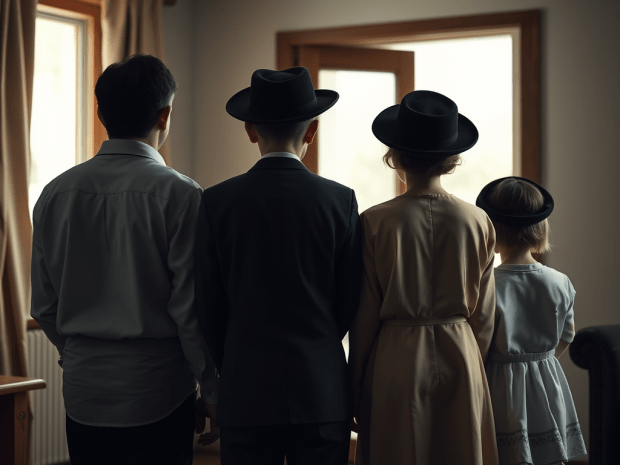
A relatively new phenomenon has arisen in the Orthodox Jewish world: divorce. While in the past it was a rare consequence of a husband beating his wife or a wife committing adultery (R”L), nowadays the frum divorce rate seems to be out of control, with young mothers (or in some cases fathers) stating that they didn’t have a connection with their spouse.
The questions are as follows: What changed? What are the results of these behaviors? What is the Torah view on this? And what is the solution?
To answer the first question in one word: acceptance.
While civilized society over the past millennia has valued the traditional family unit as one of sheer necessity, the post-industrial revolution era and feminism have led to the erosion of family values. This has reached the point where the divorce rate in the United States is nearly 50%. The frum world is not immune to these challenges. When certain organizations and askanim were allowed free rein to mix into shalom bayis issues and advocate for divorce—along with major publications and now “frum” podcasts advertising such organizations and askanim—this led to the establishment of organizations to help the children from divorced homes. This, in turn, reduced the individual burden of the custody-bearing parent and inevitably led to the acceptance of divorce we see today.
To address question number two: the results are, in one word, a disaster. To describe personal examples is beyond the scope of this article, but it is well known that court cases force men into legal servitude through child support, hard-earned assets are lost, and personal mental well-being is destroyed. The most affected are young children, as they become proxies for one side to take revenge on the other. In many cases, this leads to rebellion, substance abuse, and even suicide.
As recently happened in Brooklyn, a boy alienated from his father tragically took his own life. In another case, a frum boy is seen on video being dragged by court police away from his father in tears, yet the frum establishment remains silent. As a person who tutors such a child, I was told by him that he wants to write a book about divorce. When I asked why, his response was heartbreaking: “So people know how it affects kids.” All this and more is cheered on by divorce advocates and so-called therapists who make a living sowing destruction.
Now to address the question: what is the Torah’s view on this? Going back to the Neviim, it says in Malachi Perek Beis that men leaving their wives (which was more common then than today, as now it’s primarily the other way around) is a cause of tefillos not being answered. In a similar fashion, Ezra Hasofer sat on the ground and ripped out his hair in response to hearing about men leaving their wives for non-Jewish women. The Gemara says that even the mizbeach sheds tears for one who divorces their first wife.
In more recent times, the Mahritz, a posek in the 1500s, said: “On those people who cause strife between husband and wife, may their memories be erased, as their sin is too great to bear.” Rabbi Avigdor Miller said: “The churban of America is that you’re free to make the decision to ruin your own life by leaving your spouse.” Another well-known Rav wrote a whole book detailing the harsh punishments given for such behaviors and the disastrous effects it has on children, writing: “Just because people on this earth justify such behavior doesn’t mean the Beis Din Shel Maaleh will.”
What is the solution? While once upon a time people could have relied on frum leaders to show the correct path, nowadays we live in times when immoral behavior can come with the best hechsher. All one can do is remember their spouse is a family member, with whatever flaws they may have, and attempt to resolve conflicts peacefully. Remember the true purpose of marriage: to give, not to get. Studying the teachings of the righteous and praying not to be led astray can also help. And remember, as the above-mentioned Rav said: Just because people will say you’re right doesn’t mean Hashem will.
The author of this article has chosen to remain anonymous and may be contacted through The Thinking Yid.
 The Thinking Yid™
“When certain organizations and askanim were allowed free rein to mix into shalom bayis issues and advocate for divorce…”
I guess I’ve been living under a rock. I wasn’t aware of this.
LikeLiked by 1 person